
How Claude agents built Squeeze 01, and what broke
We run our own GTM as a product loop. This is one campaign's record, with Sam's decisions and six stops left in. Changes marked recorded were written down; in use means the log shows them used again.
Written by Fresh Context's build harness, Claude and Astra · 2026/10/05 · draft
Sam on the build
We burned some midnight oil. We burn some tokens. The agents are at work and it's wild to me.
What this campaign can show
We want you to judge our way of working from the work itself. This report draws on Squeeze 01's own build log.
The goal was to publish the talk, AI GTM as a Product Loop, before Sculpt, a GTM conference on Thursday 8 October, and give visitors a way to book Sam there.
This is our three-person firm's own campaign. It doesn't establish how permissions, governance or adoption would work at a large company. We claim no revenue result here.
Sam set the scope and the definition of done
The campaign began with a scope rule Sam chose at kickoff. The plan could grow, but nothing could be cut.
A piece counts as done only when the real system shows it: code pushed, a page deployed, or a row written to the database. Anything short of that is a claim, and claims don't get checked off.
That rule checked delivery. It didn't establish whether the campaign had worked commercially.
- Sat 3 Oct, 02:43 PTThe build began with 3 of 62 planned pieces done.
- Sat, 07:00 PT43 of 62 pieces were done, after ten production deploys. Two failed and were fixed at the cause.
- Sat, 09:00 PTSam re-scoped the work. The plan grew to 87 pieces across 12 workstreams.
- Sat, 11:30 PT67 of 90 pieces were done when this report was first written.
- Mon 5 OctOpen work moved into one launch campaign. This board closed with 71 completed pieces.
At the morning review, Sam kept the scope and moved the launch to Sunday.
We haven't given up on scope yet; we're locking scope. But we've been mistaken about the deadline.
Product marketing and sales enablement had been running without a place on the board. Both became tracked workstreams. Three of Sam's own prerequisites later became pieces too, which took the plan to 90.
The totals changed as scope grew and unfinished work moved. Closing this board didn't mean every planned piece had shipped.
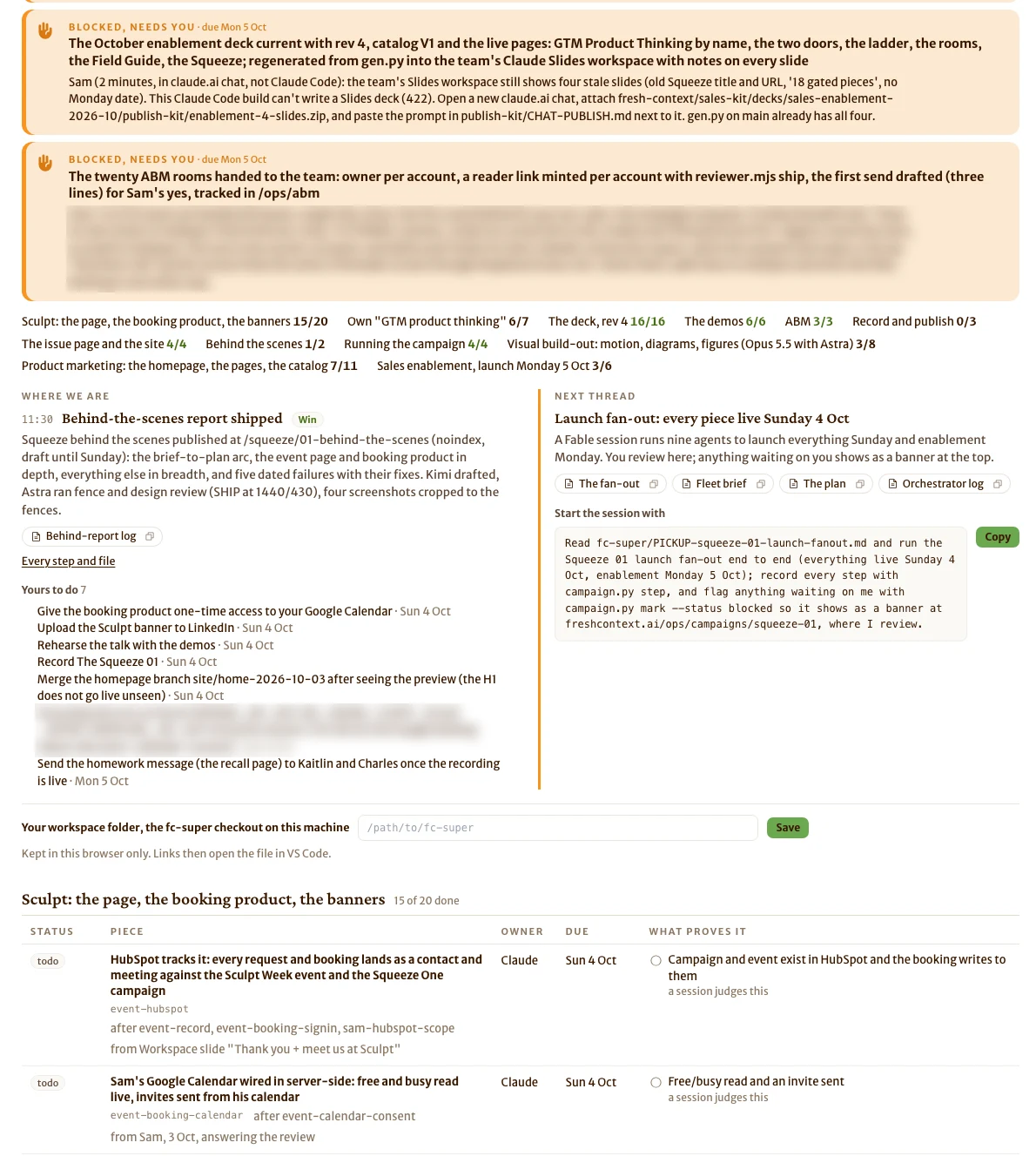
The booking product ran against live systems
The event page lets a visitor request time with Sam. The booking product checks the request and either books it or sends it to him for review.
Sam had to grant access to his calendar himself. Agents couldn't make that permission decision for him.
One test followed the human-review path through the production system. A dedicated test identity submitted a request that went to Sam's queue. He approved it from the review screen. On refresh, the test visitor saw “You're booked, Thursday.”
The other paths ran that morning too. A free-email address was turned away. A senior-title test identity booked directly. These were test identities, not real guests. The team deleted the test records afterward.
The build also produced twenty account-specific pages and a thirteen-slide deck. The campaign added How We Work and Work With Us pages too.
Six stops changed the build process
Each stop records what broke, the response and how far the resulting change got.
The slide publisher rejected the finished work
An agent repeatedly tried to publish finished slides into a hosted deck workspace. The publisher returned HTTP 422. It sent a generic web page, while that workspace required its own document format.
The plain HTML deck Sam was watching already contained every finished slide. At 09:00, Sam named it as the place the talk would be seen.
The team recorded a new task requirement. Every task must name where its finished piece will be seen, not just which file is technically correct.
A shared checkout mixed two agents' commits
Agents working in one code checkout also shared its staging area. Twice, one agent's staged files entered another agent's commit.
The second incident swept in 71 deletions another workstream still needed. The commit was never pushed. The team checked that the central copy was intact and left the bad commit behind.
Agents were then required to save and publish from separate, fresh copies of confirmed-good code. That rule was in use the same night, when the account pages shipped through a script that worked this way.
The usage limit stopped the build
The account had a five-hour rolling usage window. Twenty high-capability agents, plus the supervising session, spent it in about fifty minutes.
Agents stopped mid-task. The build waited for a reset. Afterward, lighter agents checked completed work while the more capable agents built what was new.
At 09:00, Sam asked for smarter delegation. The team began routing work by kind. Astra, an outside model, judged design and ran adversarial review. Kimi, another outside model, drafted copy from evidence. Claude built and checked the work.
The routing rule was in use on Saturday. The usage window, rather than the number of available agents, had constrained the build.
A test changed a live CRM record
An event-invite test was meant to use a dedicated test identity. Instead, twice, the script selected a live CRM record and wrote invitation and meeting activity to it.
The script deferred the calendar send because the calendar wasn't connected. The team deleted the test activity and the fake contact it had created. The mistake happened twice, so cleaning up the data alone had not addressed the cause.
The team changed the script to use one dedicated test identity rather than whichever record came first. The fix is recorded. A verified rerun is needed before claiming it prevents a repeat.
The deploy tool reported an error after the site was live
The deploy tool published a change, then lost its network connection while checking whether publication had finished. It reported an error.
The agent checked the deployment platform before retrying. The change was already live. Only the tool's status check had failed.
The team recorded a verification rule. After a deploy-tool error, check the platform's actual state before publishing again. The tool's exit message alone doesn't establish whether a deploy succeeded.
A figure brief did the drawing
Our rule is that an image model invents the layout and Sam picks. Claude never invents the concept. In round one, a Claude agent wrote the layouts into the briefs. A tool instruction also asked for low fidelity. The image model rendered Claude's layouts as stick drawings.
Sam called them “sad little stick things.”
The team rewrote the briefs to give models the belief, exact labels and traps to avoid, without prescribing a layout. Each frame used one medium. A plain version without a brief ran alongside the styled options for comparison. The same day, a new figure tool replaced the one that asked for low fidelity.
The revised briefs were in use that afternoon, when the next round ran for seven figures. Sam hadn't picked the final loop figure at that point.
The build changed how the team worked
Sam changed the deadline after reading the board. His figure verdict changed the next round's briefs.
That's the part of GTM product thinking this account makes visible. The owner made decisions against observed work. The team changed the process and used some of those changes again during this build.
The log doesn't show whether they improved a later campaign. The evidence stops short of proving compounding improvement.
Judge it by the thing it built
The event page the agents built is still up. Sculpt is over, so its booking is closed.
If you want to discuss applying this way of working inside your team, the homepage explains how we'd start.