
We tell you whether to fund your next AI investment in GTM.Four weeks, $40,000, fixed.
The AI proposal is on your desk. The saved hours haven't reached the plan. The CEO is asking what the spend returns. If there's nothing worth funding, we tell you in week one, and you keep the work either way. We work with B2B GTM teams past the pilot stage. Your AI spend is on the books, and there's no plan-level number to show for it.
Start with the AI × Revenue Plan Review. A proof run can stand alone. The two practices only follow a win. We don't sell software or licenses, so a readout that says don't build costs us, not you.
Twenty minutes with Sam Gong, the founder, on his calendar.
You'll walk into the CEO's office with the evidence
The review spends four weeks on two questions: where your plan is at risk, and where work waits between your teams. Every finding ties to a plan variable you forecast. Your program manager runs it with us, four hours a week, and your leaders make the call in the room. We grade the evidence, not the people. If the evidence says your plan holds, the CEO note says so.
AI × Revenue Plan Review
$40,000, fixed
We answer two questions: where your revenue plan is at risk, and where work waits between your teams. You leave knowing whether to fund the fix; we both leave knowing whether to work together; if it's no, we say so, and you keep the work.
You pay $20,000 on signature and $20,000 on completion. A project that follows waives the completion payment, since the review was its first phase and you never pay twice for the same work.
How the weeks run
Week one
The plan, in your own model
We walk this year's number in your driver model and find the two or three plan variables that carry the most risk, with reachable work behind them.
Weeks one to three
The work behind the numbers
We interview the teams that produce those variables. We trace one recent asset from decision to live, and one strategy change through the org. We read any proposal on your desk against the same evidence.
Week four
Your leaders decide, in the room
Your leaders run the decision through the findings and leave with a verdict: fund it, change a rule, leave it alone, or name what we couldn't test.
What you keep
The decision document
Each finding runs one chain: the plan variable at risk, the observed delay, the graded evidence, the recommendation, and who can act.
The backlog
Every item is marked greenlight, explore or drop, with the internal route and third-party route named beside any of ours.
The one-page CEO note
It reads like your board deck: the decision, the evidence, the open risks on one page.
The map
We draw the work we reviewed on the AI x GTM map's canvas, every statement labelled said, inferred or observed.
Plan owners give two hours in week one, and leadership gives thirty minutes a week plus ninety in week four.
When we walk away
Week one, not week four
If there's no reachable work behind the variables carrying your risk, we tell you in the first week.
A stop at week two
If the minimum isn't reachable - your plan walkthrough, one traced asset, interviews in three functions - either side stops and it costs $20,000, nothing more.
The readout can say don't build
Leave it alone or change a rule is a real outcome. We don't sell software or licenses, and every engagement is fixed scope with an end date, so a readout that says don't build costs us, not you. If we don't fit, we name the firm that does.
Take the AI proposal on your desk and ask your team which variable in this year's revenue plan it moves, and by how much. If nobody can answer, that's the review's first week.
Proof runs ship one fix, with a before and after
Three proof runs a function head can buy on their own: each fixes one problem, with a before, an after and an owner on your side.
Who you go after
A deep read of your named accounts, built for your sellers and account teams; breadth follows.
We read a shortlist of your named accounts: stated strategy, their AI moves, their GTM org against peers, what their leaders say in public. Priorities are scored against the plays your team funds, reasons shown. Your team owns every send; we never send for you.
What you publish
Event pages, campaign pages and small apps go from brief to live without the handoffs.
We build on your design system's own components and checks. Your designers keep the pages that need judgment, and legal and factual approval stay where they are.
How you get found
We compare what AI answer engines say about you with what you claim, then fix the biggest gaps.
The fixes land on your own pages. We built this twice, once at WorkSpan and once for ourselves. We don't run an ongoing search practice, so long-term remediation sits outside the run.
We run our own GTM this way
The Squeeze is our public notebook; issue 01 shows the shared harness we run our own GTM on.
The team ran a 230-person B2B marketing org at Adobe, then built an AI-native marketing function at WorkSpan that tripled pipeline per rep on the same headcount, and took an AI workforce platform from concept to nationwide deployment.
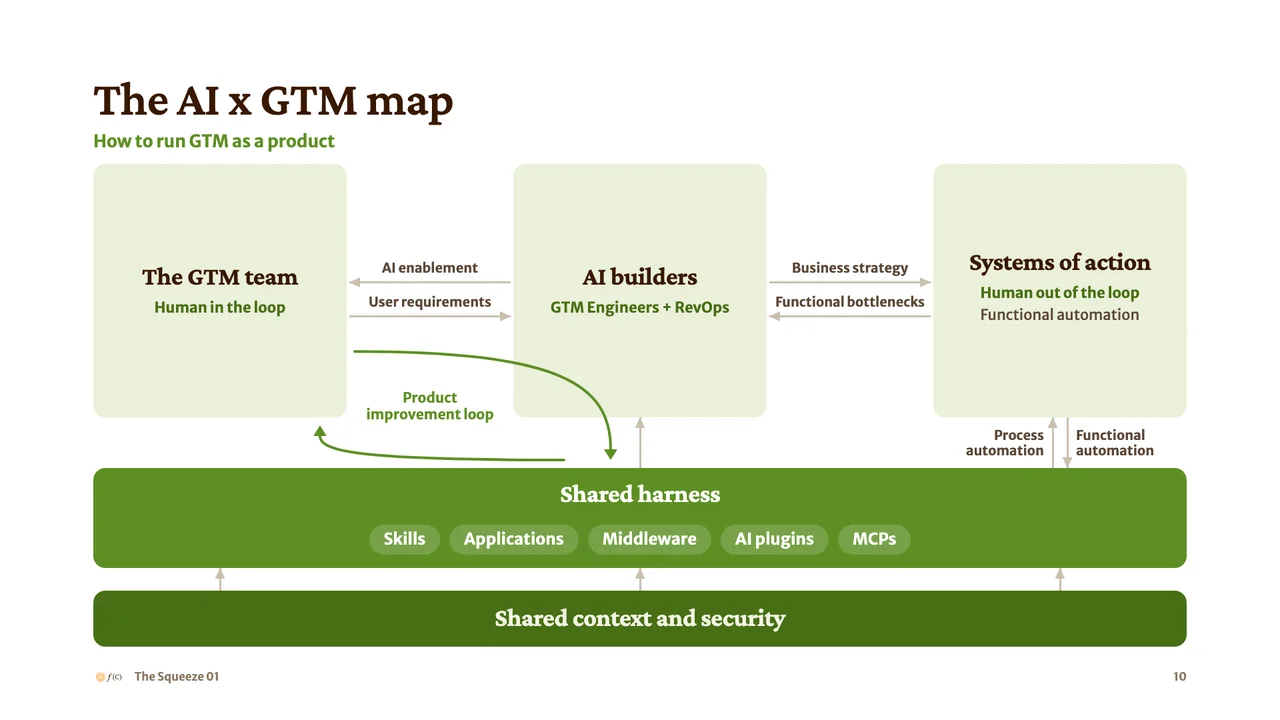
 The Squeeze · Issue 01GTM Product Thinking, in practiceA shared harness for the whole GTM team, designed around the buyer and run as a product loop by AI builders, and the map that puts it together. With the demos run live.
The Field Guide holds the principles, dated and shown on our own work. GTM product thinking is the first: GTM run as a product, with an owner and builders who fix it once for everyone.
The two practices come after something has won
These run for months, cross-functional, and only inside an account where a review or proof run has already won. Neither is ever a first engagement.
Your GTM context system
We build one approved source of what you sell, to whom and the proof; every AI workflow reads it.
Your builders build it with us, in the tools they already use. A messaging change published once shows up in every workflow. Brand context lives as a layer inside it.
Read the principleTwenty minutes tells you if we fit
Bring the proposal on your desk. If we're the wrong firm for it, twenty minutes is all it takes to find out.
Sam is at Sculpt in San Francisco on 8 October; book twenty minutes with him there.